Buying property in Dubai is one of the most attractive investment and lifestyle decisions for residents, expatriates, and international buyers. With competitive mortgage rates, flexible payment plans, and strong market growth, the UAE offers excellent opportunities for property ownership — but understanding the mortgage process, eligibility criteria, and associated costs is essential before committing.
This comprehensive guide from YOUAE Mortgages walks you through everything you need to know about obtaining a mortgage loan in Dubai: eligibility, minimum down payment requirements, mortgage types, fees, required documents, and the full application process.
1. Who Can Apply for a Mortgage in Dubai?
1. UAE Residents (Employed & Self-Employed)
Most financial institutions offer competitive mortgage products for residents with stable income. Requirements usually include:
• Minimum monthly salary (typically AED 8,000 to AED 15,000)
• Good credit history checked via Al Etihad Credit Bureau
• Valid UAE residency visa and Emirates ID
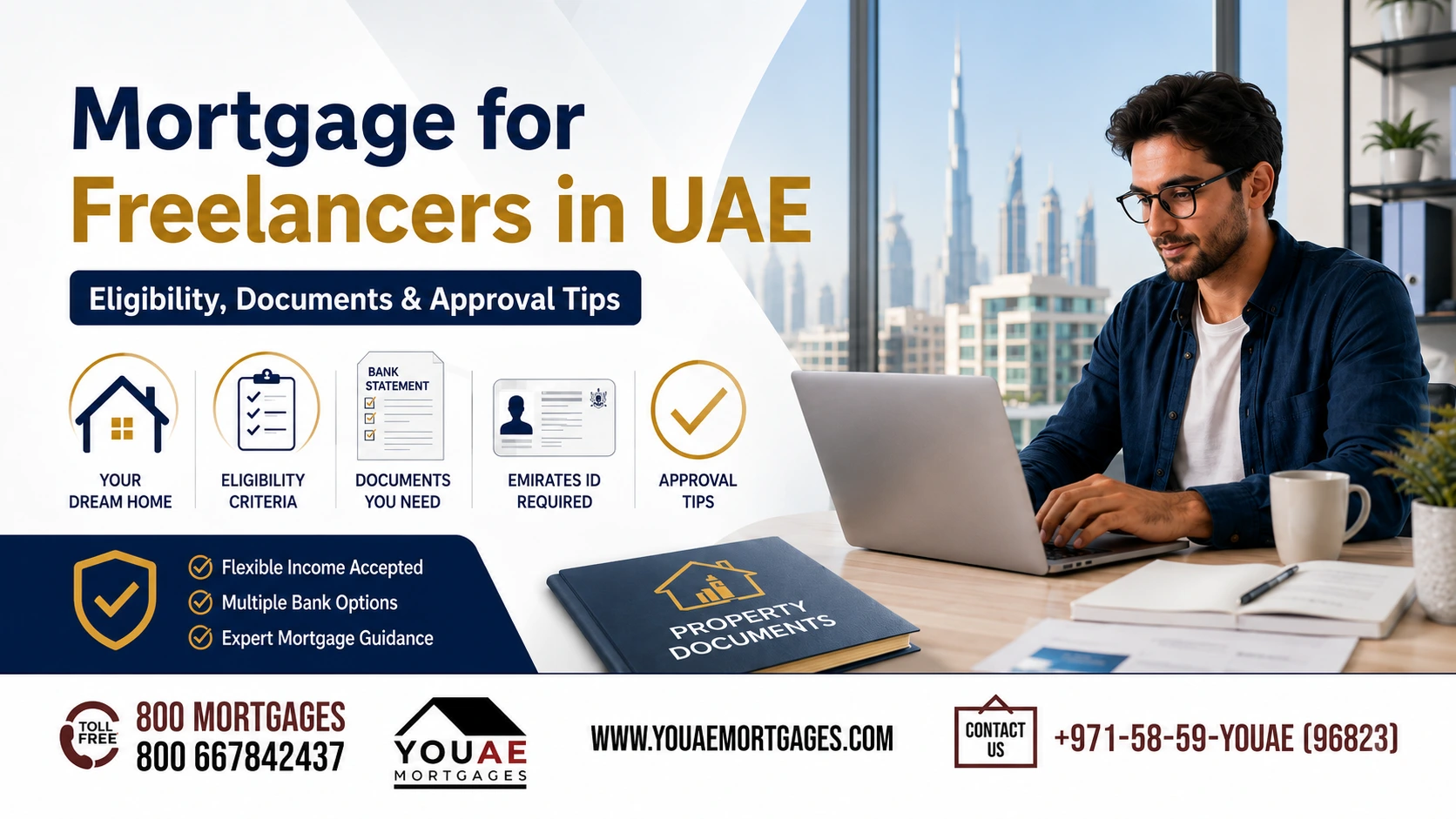
• Salary certificate or financial statements for self employed applicants
• Proof of employment or business ownership
2. Non-Residents and International Buyers
Foreign buyers without UAE residency can also obtain mortgages, although with stricter conditions. Banks commonly offer:
• Financing up to 50% of the property purchase price
• Higher variable interest rates and bank margins
• Limited mortgage options and loan terms
• Eligibility dependent on property type and designated freehold areas
3. UAE Nationals
Emirati citizens enjoy the most favourable lending terms, including lower minimum down payment and higher loan-to-value ratios, supported by government-backed schemes.
2. Minimum Down Payment and Deposit Rules
Dubai follows Central Bank of UAE regulations for minimum down payments, which vary by buyer type and property value.
For UAE Residents
- 20% minimum down payment for ready properties valued up to AED 5 million
- 30% for properties above AED 5 million or off plan units
For UAE Nationals
- 15% down payment for properties up to AED 5 million
- 25% for properties above AED 5 million
For Non-Residents
- Minimum down payment ranges between 40 to 50%, depending on property type and location within designated freehold property areas
3. Types of Mortgages Available in Dubai
Understanding mortgage options helps you select the ideal product for your financial goals.
Conventional Mortgages
- Interest-based loans with fixed or variable interest rates
- Loan term typically 5 to 25 years
- Monthly payments include principal and interest
Fixed-Rate Mortgages
- Interest rate remains constant for a fixed loan term (1 to 5 years)
- Predictable monthly payments ideal for budgeting
Variable-Rate Mortgages
- Interest rates fluctuate based on the Emirates Interbank Offered Rate (EIBOR) plus a bank margin
- Monthly payments can increase or decrease accordingly
Islamic Mortgages (Sharia-Compliant)
- Offered by institutions such as Dubai Islamic Bank and Abu Dhabi Islamic Bank
- Based on Murabaha or Ijarah contracts, avoiding interest in compliance with Sharia law
- Buyer pays profit or rent instead of interest, with ownership transferred after final payment
Offset Mortgages
- Linked to a savings account to reduce payable interest
- Available at select banks with flexible payment plans
4. Mortgage Terms and Loan Tenure
Most banks offer mortgage loan terms ranging from 5 to 25 years, influenced by:
• Age of borrower
• Monthly income and financial commitments
• Property type (ready properties or off plan projects)
• Bank policies and mortgage eligibility
Longer loan terms reduce monthly payments but increase total interest paid over the loan duration.
5. Mortgage Interest Rates and Bank Margins
Mortgage interest rates depend on:
• Type of mortgage (fixed, variable, Islamic)
• Loan amount and property value
• Credit history and Al Etihad Credit Bureau rating
• Bank margin added to benchmark rates like EIBOR
Variable interest rates can fluctuate, impacting monthly payments, while fixed rates provide stability.
6. Upfront and Additional Costs to Consider
In addition to the minimum down payment, buyers should budget for several additional costs:
Upfront Costs
- 4% Dubai Land Department (DLD) property transfer fee
- 0.25% mortgage registration fees and trustee fees
- Property valuation fees (AED 2,500 to AED 3,500)
- Mortgage processing and arrangement fees (0.5 to 1% of loan amount)
- Agency commission for real estate agents (if applicable)
Ongoing Costs
- Property service charges and maintenance fees
- Home and mortgage life insurance (mandatory)
Understanding these additional costs helps avoid surprises during the property purchase process.
7. Step-by-Step Mortgage Process in Dubai
Step 1: Eligibility Check and Pre-Approval
Submit required documents such as salary certificate, Emirates ID, passport, financial statements, and bank statements. Mortgage Finder tools can assist in assessing your mortgage eligibility. Pre-approval confirms your borrowing capacity and strengthens your position when negotiating.
Step 2: Property Selection and Purchase Agreement
Choose an ideal property within your budget, considering designated freehold areas and property type (ready properties or off plan units). Work with a real estate agent to negotiate the purchase price and sign the purchase agreement.
Step 3: Property Valuation
Banks require an independent property valuation to determine market value. This affects loan amount and minimum down payment.
Step 4: Final Mortgage Approval
After valuation and document verification, the bank grants final approval, issuing a formal mortgage offer letter.
Step 5: Mortgage Registration with Dubai Land Department
Mortgage registration is mandatory for legal mortgage recognition. Pay mortgage registration fees and trustee fees to complete the process. The updated title deed will reflect the mortgage annotation.
Step 6: Property Transfer and Handover
Once registration is complete, ownership transfers, and you become the legal property owner, starting monthly payments as per your loan term.
8. Financing Off-Plan Properties
Banks finance select off plan projects, usually up to 50% of the property value. Eligibility depends on the developer, project stage, and buyer profile. Additional documentation and approvals may be required.
9. Refinancing and Early Settlement
Mortgage refinancing allows you to:
- Lower interest rates or monthly payments
- Change loan tenure or switch mortgage options
- Release equity for renovations or investments
Be aware of prepayment penalties and early settlement fees. Consult your lender to understand implications.
10. Benefits of Using a Mortgage Broker in Dubai
Mortgage brokers in Dubai provide:
• Access to multiple financial institutions and mortgage products
• Expert guidance on eligibility criteria and required documents
• Assistance with pre-approval and paperwork
• Negotiation support for best interest rates and flexible payment plans
• Transparency on additional costs and trustee fees
Final Thoughts
Navigating Dubai’s mortgage market can be complex, especially for first time buyers and expats buying property. Understanding eligibility, property valuation, mortgage options, and associated costs ensures a smooth property purchase experience.
At YOUAE Mortgages, our Mortgage experts provide personalised, transparent, and professional support throughout your mortgage journey. Contact us today by calling 0 0971-58-59-96823 to explore your financing options and secure your ideal property in Dubai’s thriving real estate market.
People Also Ask
Can I get a mortgage in Dubai if I am self-employed?
Yes, self-employed individuals can apply for a mortgage in Dubai. However, you will need to provide additional documentation such as audited financial statements and a trade license to prove your income stability.
What is mortgage pre-approval, and why is it important?
Mortgage pre-approval is a conditional offer from a bank indicating how much you can borrow based on your financial profile. It helps you understand your budget, strengthens your negotiating position, and speeds up the mortgage process once you select a property.
Are there mortgage options available for non-residents or international buyers?
Yes, non-residents and international buyers can obtain mortgages in Dubai, though typically with higher down payment requirements and stricter eligibility criteria. Mortgages for non-residents generally cover up to 50% of the property value.
What additional costs should I expect besides the down payment?
Beyond the minimum down payment, expect to pay Dubai Land Department transfer fees, mortgage registration fees, valuation fees, mortgage processing fees, real estate agent commissions, and insurance costs.
Can I buy off-plan properties with a mortgage in Dubai?
Yes, many banks finance off-plan properties, usually up to 50% of the property value. Eligibility depends on the developer’s reputation, project stage, and buyer profile.
How long does the mortgage approval process usually take?
Typically, mortgage pre-approval takes 3–5 working days. Final approval after property valuation and document submission can take anywhere from 1 to 3 weeks, depending on the bank and buyer profile.
What happens if I want to sell a mortgaged property before the loan is fully repaid?
You will need to settle the existing mortgage with the bank before transferring ownership. This may involve early settlement fees or penalties. The sale and mortgage release must be registered with the Dubai Land Department.
Are there fixed-rate and variable-rate mortgage options? Which is better?
Both options are available. Fixed-rate mortgages offer predictable monthly payments, ideal for budgeting, while variable-rate mortgages may start lower but can fluctuate with market rates. The best choice depends on your financial situation and risk tolerance.
Can I refinance my mortgage in Dubai?
Yes, mortgage refinancing is possible and can help you secure better interest rates or adjust your loan tenure. Be aware of any prepayment penalties or fees associated with early settlement.
Do I need to pay any fees to register my mortgage?
Yes, mortgage registration fees are mandatory and typically amount to 0.25% of the loan amount, plus trustee fees and other administrative charges payable to the Dubai Land Department.
Is it necessary to use a mortgage broker?
While not mandatory, mortgage brokers can provide valuable assistance by offering access to multiple lenders, helping with paperwork, negotiating better rates, and guiding you through the mortgage process efficiently.
Can I earn rental income from a mortgaged property?
Yes, you can rent out your property even if it is mortgaged. Rental income can sometimes be factored into your mortgage eligibility assessment, but check with your lender for specific policies.
What is the minimum deposit required for first-time buyers?
For first-time buyers who are residents, the minimum down payment is generally 20% for ready properties and 30% for off-plan properties or properties valued above AED 5 million.
How does my credit history affect mortgage eligibility?
A good credit history reported through the Al Etihad Credit Bureau improves your chances of mortgage approval and may help secure better interest rates and terms.
Can both residents and non-residents apply for the same mortgage products?
Mortgage products vary for residents and non-residents, with residents typically having access to more favorable loan-to-value ratios and longer loan terms. Non-residents face stricter conditions and higher down payments.